I told someone at work about having run the Khardung-La Challenge. His immediate question was: why would you do this to yourself? I had asked this question to myself several times during my training, and the answer fluctuated between a dopamine addiction and a mid-life crisis – or both. What is the Khardung-La challenge? It is one of India’s most legendary foot races, requiring participants to cover 72 km in 14 hours. That crazy distance is not the difficult part!
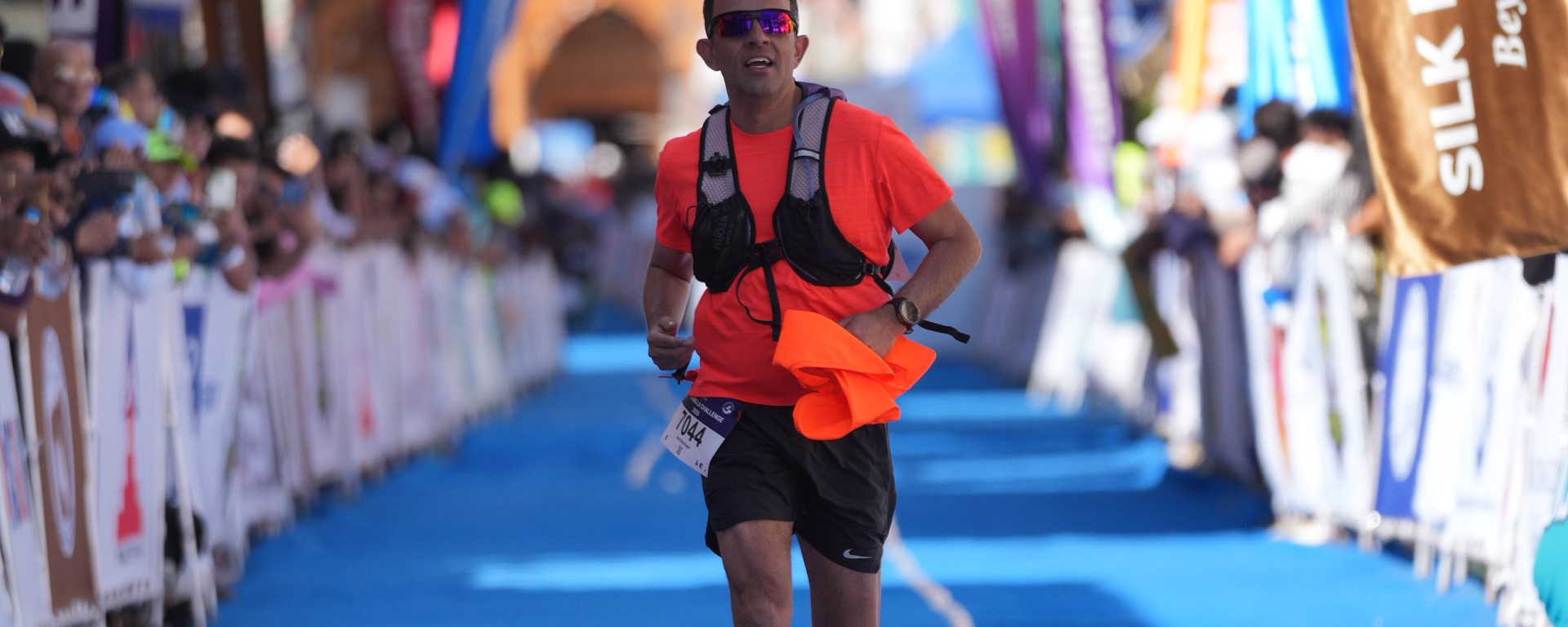
I had run twice in Leh before, a half marathon and a full marathon. These races typically happen on the second Sunday of September and the runners are required to be there for the full week before to acclimatise. Leh is at an altitude of 11,500 feet where walking is tough on the first day of arrival, so these days are needed to be able to run. Before each of these runs, on Friday afternoon, I had gone to the Leh market to cheer for the finishers of the Khardung-La Challenge (72km) and Silk Route Ultra (122km). The market has the most amazing festive look. A blue carpet is rolled out through the main road with barriers on both sides. A large crowd gathers on both sides of the carpet to cheer for the 300 or so finishers who start arriving by mid-morning and roll in till the hard cut-off at 5pm. The atmosphere is totally electric, the energy is incredible and every finisher is made to feel like a super hero. This finish line is like no other. When I watched from the sidewalk side of the barriers, the desire to be on the blue carpet side was immense.
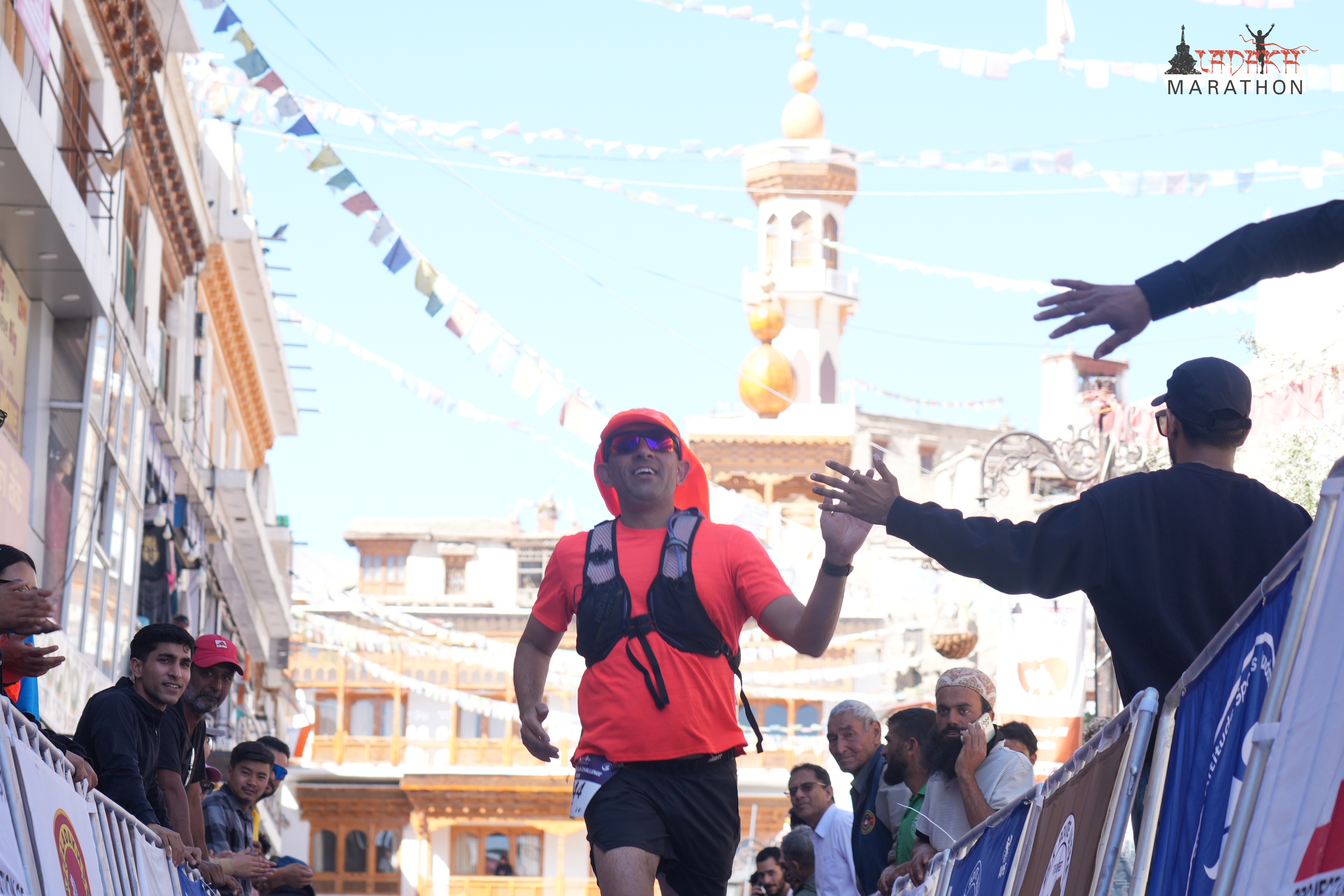
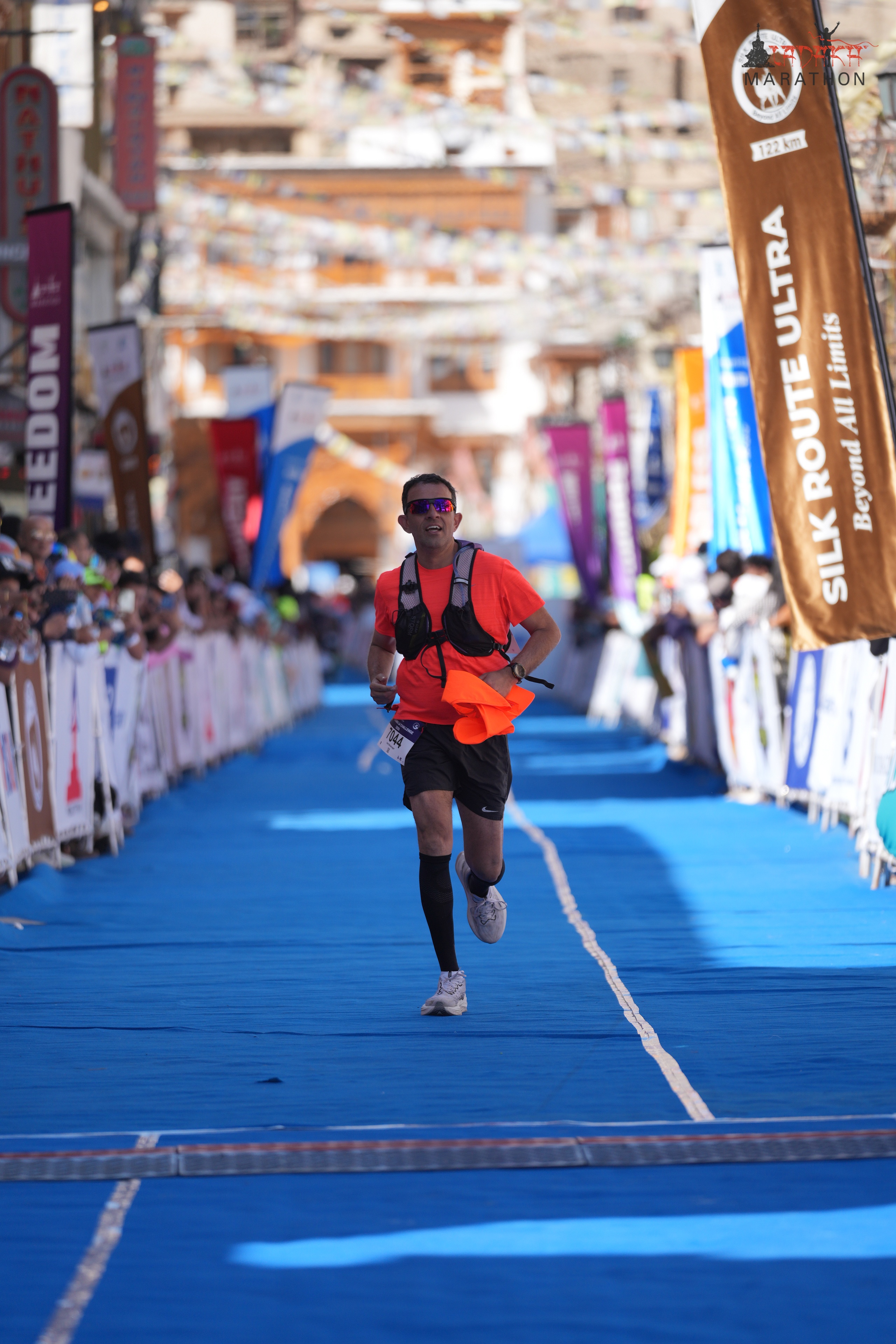
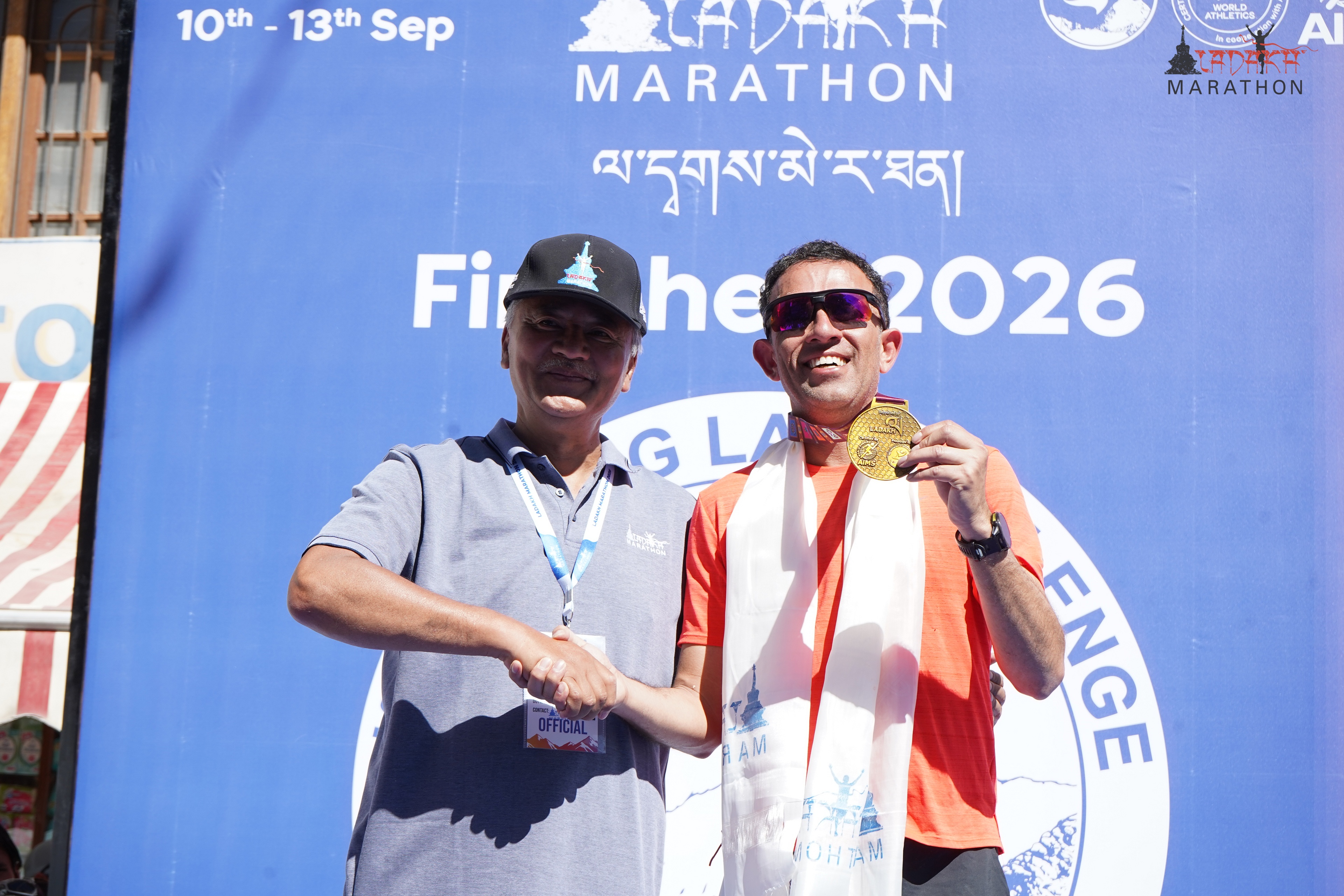
My own chance to be on the carpet side of the crowd barriers came after about 11 hours and 12 minutes of insane terrain. My legs felt like lead, I had just started to cramp in my left hip, and the mountain Sun was starting to burn through my cap. The sight of that market made me forget all of that! I sprinted the last 500meters, clapping hands with the crowds, accepting their greetings and the applause. I even took off my cap so I could get a better click and bowed as I ran across the finish line and then almost collapsed in the recovery tent. That was my 2 minutes of fame! I finished in 11:14 hours.
But that was the end. Four kilometres earlier, at about km 68, the course takes a right turn around a petrol pump into Leh town. The course changes from an incredibly beautiful downhill terrain to city roads. By this time my mind was just waiting for the finish line. I knew there are many kilometers to go, but at every turn I was hoping to see the market entry. The run had now slowed down to a jog or a walk on some uphill sections. There are houses on both sides, so I came across locals, who congratulated and encouraged. Several of them said that the end was just five minutes away. It wasn’t! This section was a bit of a drag, but then there were people around and I saw several runners in the same situation as me. Fortunately, it isn’t really very long, it just feels like it.
There are two bag drop points on the route. Each runner can drop off things they want on the way but then they can also use these bags to take off layers of warm clothing. The bags are delivered by the organisers at the finish line. The second of these drop off points is South Pulu – an army station at an altitude of about 15,300 feet. There is a little over 25 km of the race to go beyond South Pulu and most of it is downhill. While downhill running isn’t as easy as it sounds, it is hard on the knees, this is the first point where I felt certain that I was going to finish the race. The drop in altitude makes running slightly easier and the increase in temperature meant I could get rid of my down jacket and track pants. These were left in the drop bag. The weather was pleasant with very bright Sun overhead. I was down to shorts and a t-shirt with a sun cap and while the legs were tired, I could sprint in bursts. This was the section I did best at. I overtook a lot of the runners who had overtaken me during the climb. To save my knees I was taking a short walking break after every 900 meters of sprinting. I was still faster than most on this section. The view is stunning from the hills and I could see Leh town and the Shanti Stupa all the way down. I could also see the winding roads on steep mountain slopes that would get me there. In the distance there were snow covered peaks and vast emptiness of the Himalayas. Arguably, the most beautiful place to run anywhere.
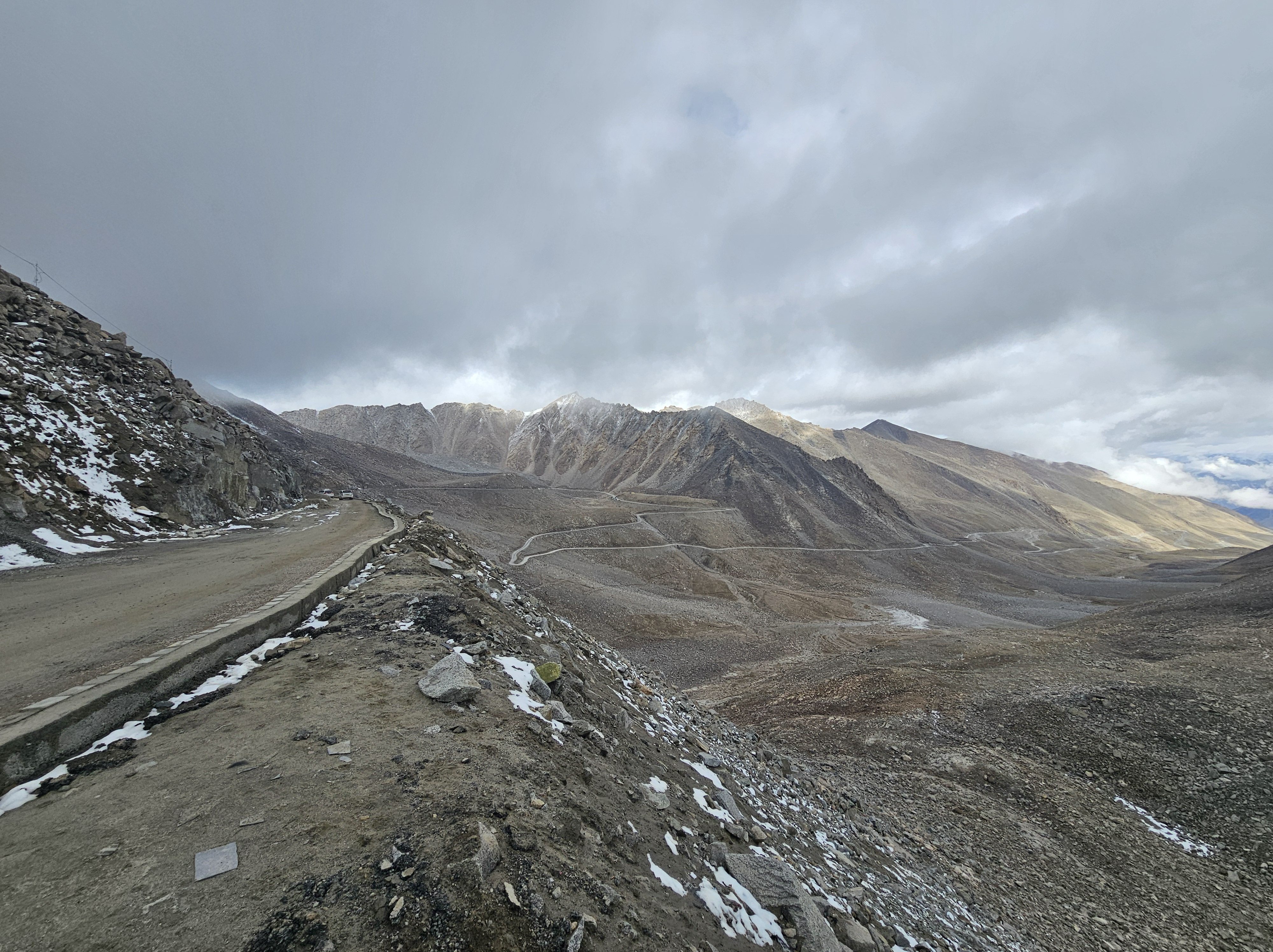
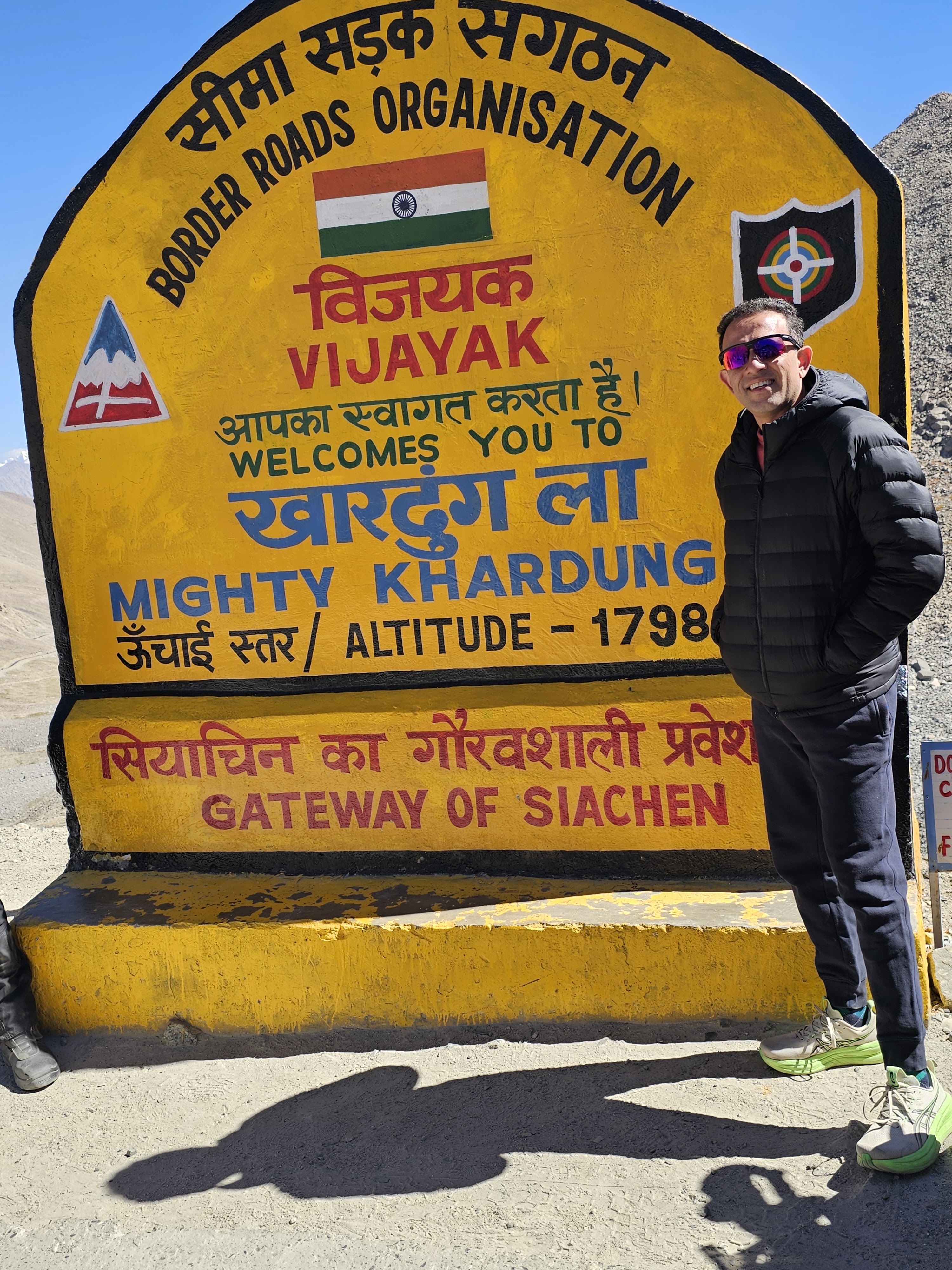
Signs on Khardung La pass tell you that it is the second highest motorable pass in the world at 18,379/ 17,982 feet. It actually is the 12th highest motorable pass at 17,582 feet. That drop in altitude doesn’t make it any easier to be there. It offers some incredible scenic views, but signs also tell you not to stay for longer than 5 minutes. Walking for more than a couple of minutes can leave you gasping for air. The pass has 50% less oxygen than at sea level. This was also the first bag drop off point in the race and obviously the place where the race changes from a climb to a descent. The temperature was still nearly zero. However, I planned to run faster downhill and that warms up the body. So I took off one warm layer and the beanie was replaced by a sun cap. I grabbed a few gels, swallowed an ibuprofen, and stuck to the advice of not staying at the top for very long. I was still finding it hard to breathe while running so the first few kilometers were still a brisk walk. Everyone else seemed to be doing the same. I had to gather the courage to try a run. The first attempt lasted 100 meters followed by a sip of water. It took a few attempts to get that 100 meters up to 900 and then I felt a lot better and comfortable. This felt a lot more like the racing I was prepared for. I was able to sprint and overtake a lot of runners and still protect my legs. I had crossed the pass at hour 6:30, an hour slower than I planned but still 1.5 hours ahead of the intermediate cut-off. In my mind if I made it to South Pulu (14.3km downhill) in another 1.5 hours, I would feel a lot more confident. I just made it!
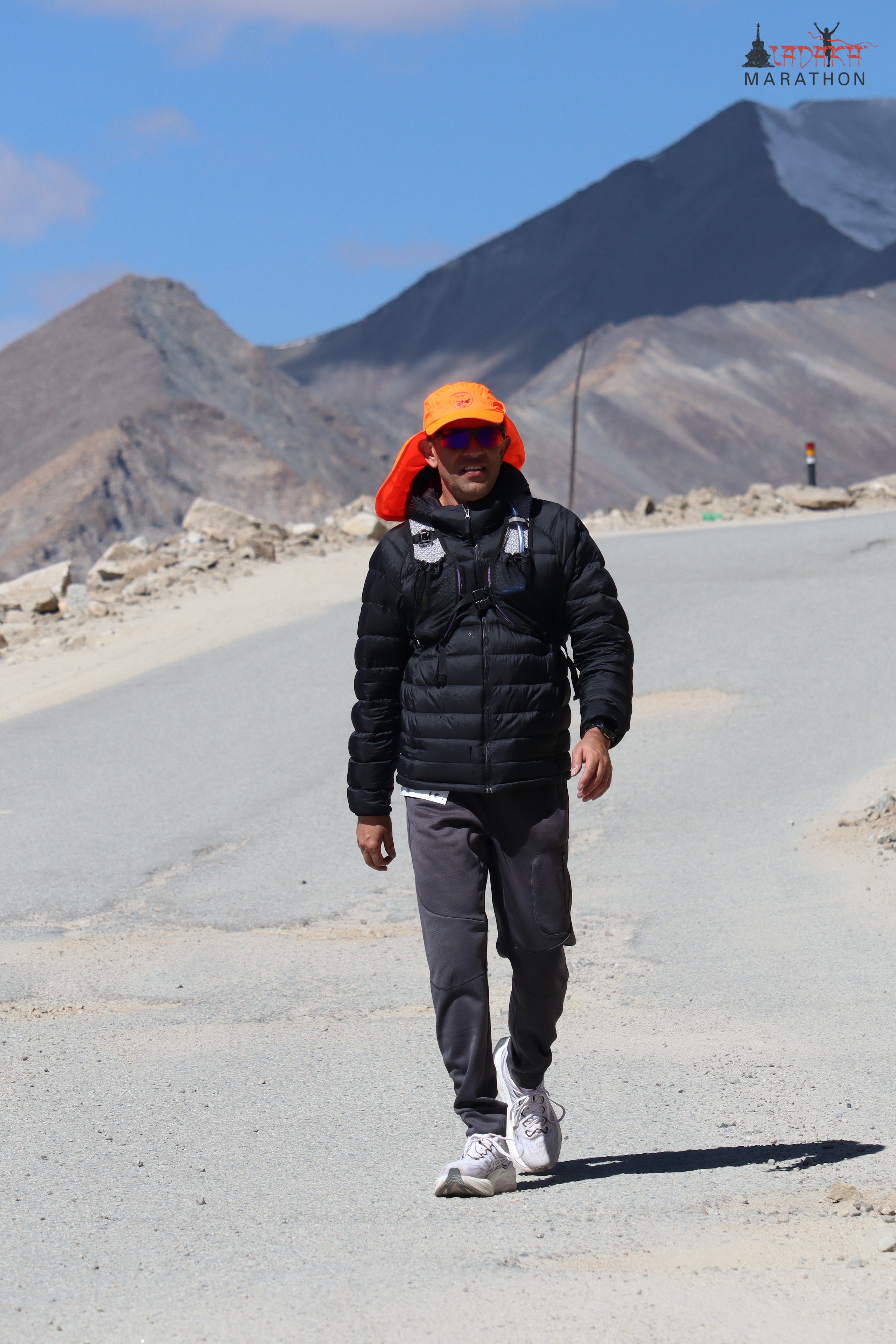
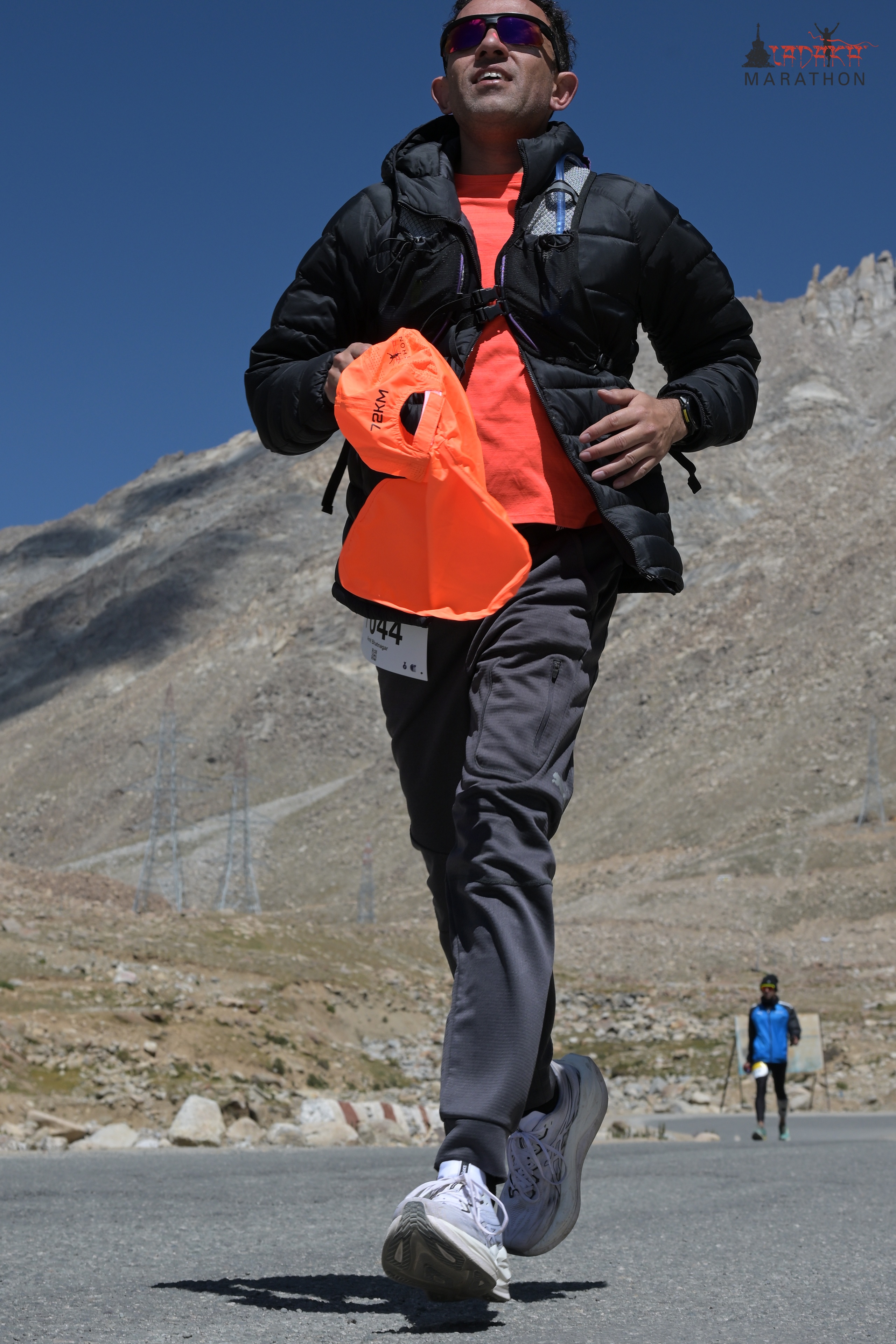
The race starts at 3am in Khardung Village at an altitude of about 13,000 feet. I had got some 2 hours of sleep the night before and I was standing next to some of the strongest endurance runners of the country at near freezing temperatures for the 3am start. There was tension and excitement in the air only balanced by the most serene view overhead – a star filled stunning sky. The attire was nothing like what you would expect in a race. I was wearing 2 jackets over my running t, track pants over my running shorts, a beanie, gloves and 2 layers of socks. The first 32 km is a steady uphill climb to 17,582 feet. There is an 8 hour intermediate cut-off to reach the top. I had planned to finish this in 5:30. We started sharp at 3, and after the first few km of a mix of run and walk, it was evident that everyone was going to brisk walk up. It was only going to get tougher as we got further up and the air became thinner. There were hydration points at every 5km with water, electrolytes and some dates, bananas or boiled potatoes. The first major checkpoint was North Pulu about 15 km into the race at an altitude of about 15,200 feet. I was there in about 2.5 hours, right on target with the Sun just coming up. The Sun wasn’t much of a worry yet, as the temperature was still close to zero. I took a minute at North Pulu to have some potatoes, gel, and hot soup. 17km to k-top in 3 hours felt doable with an easy walk – little did I know.
The further I went up the mountain, the harder the going became. I had practiced a lot of hill-repeats and short runs uphill but then never such a long walk uphill. The lack of oxygen, climbing fatigue, and lack of walking experience compounded quickly. At some point I saw my fingers were swollen to double their size. I was slowing down and runners were overtaking me steadily. Then the mind begins to play its games. I could look back and see a lot of the road I had passed and every time I saw fewer runners. From being in the top quartile of runners at North Pulu, I was near the end. My pace was dropping and I was feeling the pressure. Many times I saw a medical vehicle pass by and there was the temptation to call it quits and get on. Closer to the top of the pass, hallucinations started. I would take a turn with absolute certainty that k-top was round the corner and then I would see a long road ahead. Many self-doubts and a near torturous last hour later, I got to the top of the pass in just over 6.5 hours. Just that relief of putting the ascent behind me got my mind back in control and I got myself ready to gain back all the lost position on the way down.
The race was incredibly tough, but was there was lot to pull me through. Otherworldly scenic views of the Himalayas, amazing co-runners, and the anticipation of running through the Leh market, among many others. There is a lot more that went into this. Eleven days of acclimatisation alone in Leh (mandatory), practice runs at k-top that would give me all day headaches, 4-5 hours of practice runs in Delhi heat every weekend morning, no social life for 2 months as I needed to be in bed by 9 for the morning routine, and many days of just being tired. It was even hard on the family as I was too unavailable. The investment was intense…
That brings me to why I did it…there are many answers to the question. Maybe, the best answer is this: 3 years ago I had accidentally bought a Khardung La Challenge t-shirt, I wanted to earn the right to wear it (I wore it for 2 straight days after finishing).